


17th Century Rapier
17th Century Rapier
Origin: Europe | Culture: English or German | Period: Early 17th Century
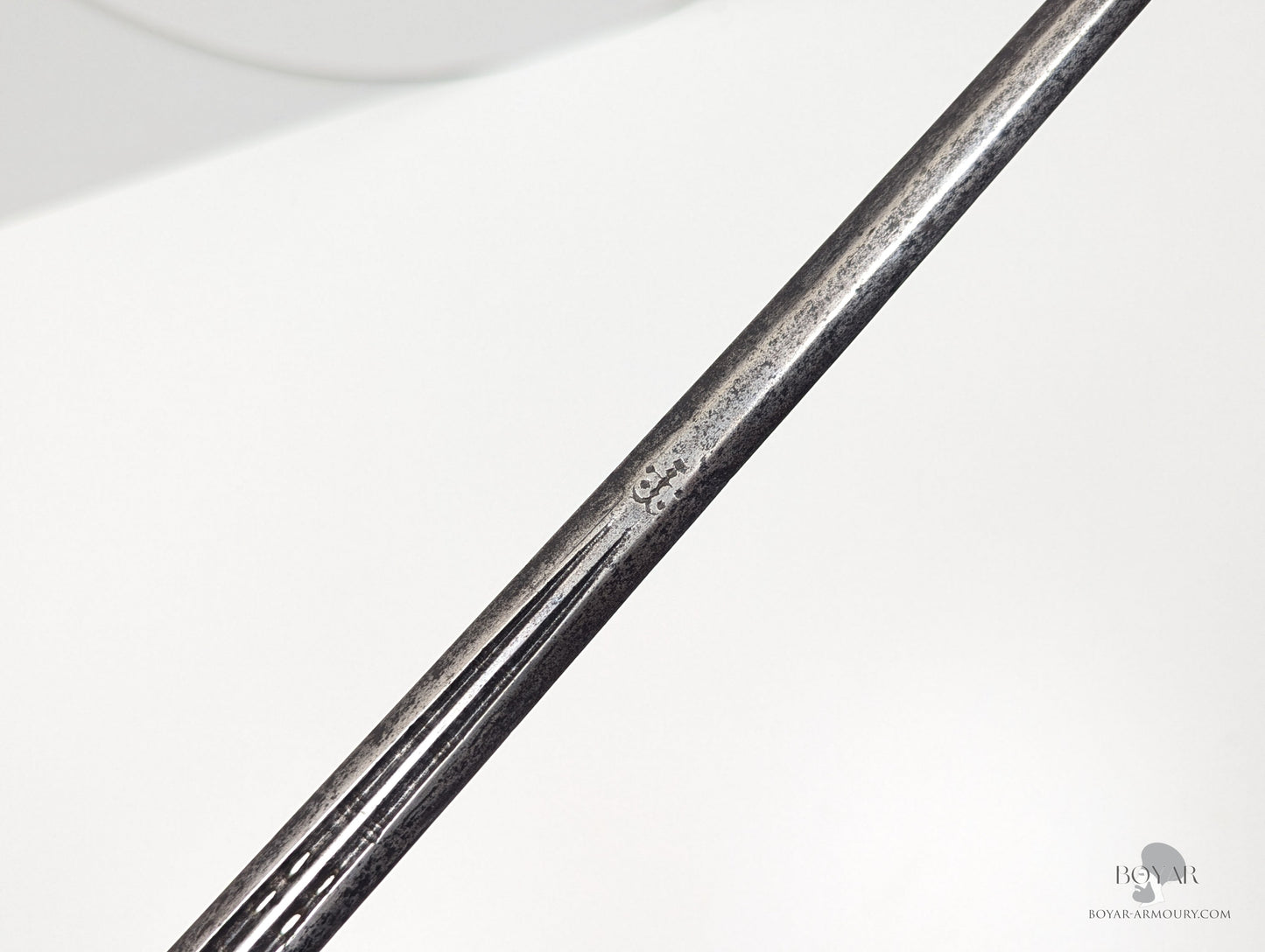
A steel hilted rapier with a hexafoil saucer, dating to 1630-45. The hilt has a pair of quillons supporting arms which divide to form two equal branches linked to the edge of a saucer-shaped guard through the centre of which the blade passes.
A style very prevalent in mid-17th century art, one such example is illustrated in a portrait of Giovanni Carlo de' Medici, attributed to Justus Sutterman, about 1642.

A comparable hilt can be found in "A portrait of an admiral" by Adrien Diericks Rodriguez, about 1640 (Munich, Alte Pinakothek, Inv. No. 981).

A similar hilt is also illustrated in the engraving "The feast at the return of the Prodigal Son" by Abraham Bosse, about 1635.

Similar examples can be found:
Museo Stibbert, Florence, Cat. No. 1408.
Musee de l'Armee, Inv. Nos. P.O.1518 & 1520.
Wallace Collection, Cat. No. A676.
Musee de la Porte de Hal al Brussels, Inv. No. 353, with a sauce made up of twelve petals.
The A676 Rapier from the Wallace Collection is described as follows:


The total length is 117.5cm, blade 99cm.
References:
"Wallace Collection Catalogues, European Arms and Armour, Volume II Arms" by Sir James Mann, London, 1962.
"The Rapier and Small-Sword, 1460-1820" by A V B Norman, London, 1980.
Source material courtesy of Mr Peter Mustonen.


Interested?
Or do you have something similar to sell?